Cenozoic Resources

Cenozoic ResourcesCenozoic ResourcesCenozoic Resources

Cenozoic Resources

Cenozoic ResourcesCenozoic ResourcesCenozoic Resources
  • Home
  • Systems R&D
  • Borehole Geophysics
  • Approach
  • Experience
  • Team
  • Company
  • Contact
  • Programs
  • More
    • Home
    • Systems R&D
    • Borehole Geophysics
    • Approach
    • Experience
    • Team
    • Company
    • Contact
    • Programs
  • Home
  • Systems R&D
  • Borehole Geophysics
  • Approach
  • Experience
  • Team
  • Company
  • Contact
  • Programs

Borehole Geophysics

We log boreholes to define lithologic boundaries, moisture distribution, and radiological contamination in the vadose zone. Our slim-hole tools were developed by Three Rivers Scientific for direct push characterization at DOE sites beginning in 2005, and Cenozoic Resources acquired the tools and their designs in 2025. They are in contract service at DOE tank farms, where we supply, calibrate, and maintain the instruments and process the log data.
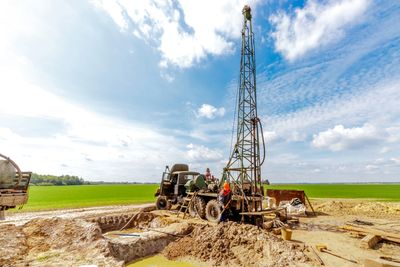
Truck-mounted drill rig advancing a borehole in open country

Logging Methods

Spectral Gamma

Neutron Moisture

Neutron Moisture

Measures gamma-ray energy spectra to identify and quantify natural radionuclides (potassium, uranium, thorium) for lithologic correlation, and man-made radionuclides such as cesium-137 and cobalt-60 for contamination profiling.

Neutron Moisture

Neutron Moisture

Neutron Moisture

Measures hydrogen content to determine volumetric moisture, calibrated from saturation (17 to 25 percent by volume) to less than 3 to 5 percent. The neutron source is supplied by the site operator and used under the site's radiation protection program.

Beta Logging

Electrical Resistivity

Electrical Resistivity

Proof of concept to detect beta-emitting radionuclides, such as strontium-90, in direct push boreholes.

Electrical Resistivity

Electrical Resistivity

Electrical Resistivity

Measures formation resistivity to distinguish lithologic units and identify changes in pore-fluid conductivity associated with contaminant plumes.

Additional Logging Methods

Electrical and Electromagnetic

Acoustic, Imaging, and Geometry

Acoustic, Imaging, and Geometry

  • Spontaneous potential and single-point resistance
  • Normal and four-point resistivity, induced polarization
  • Dual induction conductivity
  • Magnetic susceptibility

Acoustic, Imaging, and Geometry

Acoustic, Imaging, and Geometry

Acoustic, Imaging, and Geometry

  • Full-waveform sonic and P-S suspension logging
  • Acoustic and optical televiewers, including UV imaging
  • Borehole video
  • Three-arm caliper, deviation, and gyroscopic navigation

Fluid, Flow, and Formation

Fluid, Flow, and Formation

Fluid, Flow, and Formation

  • Fluid temperature and resistivity; water quality (pressure, temperature, conductivity, pH, chlorophyll, redox)
  • Heat-pulse, impeller, and spinner flowmeters; fluid sampling
  • Borehole magnetic resonance for porosity and pore-size distribution

Nuclear

Fluid, Flow, and Formation

Fluid, Flow, and Formation

  • Gross gamma, high-rate gamma, passive neutron, and infrared casing temperature
  • Natural and spectral gamma combination probes with SP and SPR

CR-HE/HR Direct Push Geophysical Tool Assembly

Specifications

The CR-HE/HR is a slim-hole geophysical tool assembly for direct push boreholes. Its gamma combination tool pairs CeBr3 and BGO detectors with an infrared temperature sensor, so contamination and temperature anomalies can be located in place before any sample is collected.

  • Gamma combination tool: CeBr3 and BGO detectors, 1.5-inch outside diameter, 51 inches long
  • Neutron moisture tool: 1.5-inch outside diameter, 29 inches long
  • Additional tools: high-rate NaI gamma, beta, and passive neutron
  • Deployment: 2 5/8-inch OD direct push tubing and monitoring casing
  • Winch: cart-mounted portable system; no logging truck required
  • Spectral logging rate: 100 to 200 seconds per 0.5 foot
  • Gross gamma logging rate: 4 feet per minute
  • Temperature: 0.50 °F detection limit, relative measurement optimized for anomaly detection

CR-HE/HR slim-hole spectral gamma logging tool

Direct Push Logging Compared with Drilling and Sampling

Direct Push Logging

Conventional Drilling and Sampling

Conventional Drilling and Sampling

  • Vertical coverage: continuous profile of the full depth
  • Dust: none generated
  • Investigation-derived waste: negligible
  • Off-site shipping: no radioactive samples shipped
  • Worker exposure (ALARA): no handling of contaminated cuttings or samples
  • Preliminary results: within 24 hours

Conventional Drilling and Sampling

Conventional Drilling and Sampling

Conventional Drilling and Sampling

  • Vertical coverage: discrete samples at 2.5- or 5-foot intervals
  • Dust: generated during drilling and sample handling
  • Investigation-derived waste: drill cuttings require characterization and disposal
  • Off-site shipping: samples shipped to an off-site laboratory
  • Worker exposure (ALARA): cuttings and samples handled at the surface
  • Preliminary results: laboratory turnaround

Instrument Optimization and Deliverables

Instrument Optimization

We configure each logging tool for the borehole it will run in. Detector type (CeBr3, BGO, NaI, or Geiger-Müller), shielding geometry, and acquisition settings are selected for the borehole diameter and casing, the expected activity, and the required detection limits. The result is a tool that does not saturate in high-activity intervals and keeps its resolution in low-activity intervals.

Deliverables

  • Processed spectral gamma, neutron moisture, temperature, and beta logs, depth-registered and correlated to geologic logs
  • Radionuclide-specific concentration profiles
  • Petrophysical interpretation of lithologic boundaries and moisture distribution
  • Data packages with a certificate of quality documenting validation
  • Preliminary direct push results within 24 hours

Calibration and QA/QC

Hanford Borehole Calibration Models

Our gamma and moisture tools are calibrated annually, and after major repairs, at the Hanford borehole calibration models. The spectral gamma models (SBK, SBU, SBT, and SBM) were built by DOE's Grand Junction office in the 1970s and are tied to DOE's primary borehole standards in Grand Junction, Colorado; each holds known concentrations of potassium, uranium, and thorium.

The neutron moisture models, shown here, are six steel-cased standards (6- and 8-inch casing at about 5, 12, and 20 percent moisture by volume) plus a thin-bed model. Our Chief Scientist co-authored their 1996 calibration (WHC-SD-EN-TI-306).

  • Moisture calibration supported by MCNP modeling
  • Background and daily functionality checks; pre- and post-survey source checks, with repeat logs within 10 percent RPD
  • Depth calibration with a NIST-traceable tape, three runs within 1 foot
  • Methods per API RP 33, ANSI N42.12 and N42.14, and ASTM D5753 and D6274; data validated under HASQARD Volume 3 and certified in each data package

Neutron moisture calibration models at the Hanford Site borehole calibration facility

Planning a logging program?

Send the borehole count, depths, casing size, and expected activity. We will scope the tool string, calibration, and reporting, and quote the program.

Discuss a Project

Cenozoic Resources, LLC

Woman-Owned Small Business (WOSB)

UEI JWAYS2RN7MK8

CAGE Code 13CQ3

NAICS 541360

Pasco, Washington

James.Patterson@CenozoicResources.com

Copyright © 2026 Cenozoic Resources, LLC. All rights reserved.

This website uses cookies.

We use cookies to analyze website traffic and optimize your website experience. By accepting our use of cookies, your data will be aggregated with all other user data.

Accept